
The Illusion of the Bass Boost
Few studio frustrations are more disorienting than a low end that behaves like a ghost. An 808 kick feels enormous at the console, then vanishes three feet to the left. A bassline sounds tight in the chair but turns into a soft, booming cloud in the car. The room seems to approve one note while erasing the next, leaving every decision about weight, punch, and headroom suspended in doubt.
The natural response is to reach for software. A room-correction plugin promises a straighter curve, while a parametric EQ offers immediate control over the frequencies that appear too loud or too quiet. Digital processing is fast, repeatable, and familiar, which makes it an appealing first move for home producers working in bedrooms, spare rooms, and compact project studios.
But a room problem is not merely a frequency-response problem. It is a physical interaction between loudspeakers, boundaries, listening position, and reflected energy. Equalization can reshape the electrical signal, but it cannot move a node, shorten a modal decay, or restore acoustic energy that cancels before it reaches your ears. The route to dependable translation begins with standing waves and phase cancellation, then moves through measurement, positioning, and substantial low-frequency treatment.
The Physics of Standing Waves and Destructive Interference
Low-frequency sound has wavelengths comparable to the dimensions of many domestic rooms. When a monitor sends bass toward a wall, the reflected wave returns and meets the direct sound. Depending on the frequency, timing, and position in the room, the two waves can reinforce each other, creating a peak, or oppose each other, producing a deep null. Move only a short distance and the relationship changes, which is why bass can surge at one point and disappear at another.
Parallel boundaries make this interaction especially persistent. Reflections continue to travel between walls, floor, and ceiling, creating resonant patterns called room modes. At particular frequencies, pressure and velocity organize into stable zones of maximum and minimum energy. The foundational behavior of these energy traps and boundary cancellations is described in this standing-wave explanation.
Room modes are commonly divided into three groups:
- Axial modes involve two opposing surfaces, such as the front and rear walls, and usually dominate small-room coloration.
- Tangential modes involve four surfaces, such as both side walls and the floor or ceiling.
- Oblique modes involve all six room boundaries and generally distribute their energy more thinly.
Axial modes are particularly troublesome because compact rooms place the listening position and loudspeakers close to the boundaries that create them. A mode can produce a strong antinode near a wall and a cancellation zone farther into the room. In a severe null, the acoustic pressure at a particular frequency may approach zero. Sending the amplifier more of that frequency does not change the geometry. In practical terms, zero multiplied by a digital gain boost still produces silence at the cancellation point, while the rest of the room receives unnecessary energy.
The Dark Side of Digital EQ and Room Correction
Forcing a large boost into a null is one of the most expensive ways to make a room appear cooperative. A correction filter that adds 12 dB at a missing bass frequency asks the amplifier and loudspeaker driver to work dramatically harder. The result may be reduced headroom, mechanical stress, audible distortion, or limiting, even though the listening position still lacks the intended bass. The extra energy often accumulates elsewhere, where the same frequency is already strong.
EQ also treats the symptom in the frequency domain while leaving the room’s time behavior intact. A modal peak may be reduced in level, yet the stored energy can continue ringing after the original bass note has stopped. That lingering decay smears successive notes together, creating the familiar one-note bass effect. A correction curve can make a response chart look more orderly without making the room acoustically quieter or faster.
| Low-end metric | What digital EQ can change | What physical treatment changes |
|---|---|---|
| Steady-state peak | Often reduces level at the measurement position | Can reduce the buildup across a wider area |
| Deep null | Cannot reliably restore cancelled energy | Positioning and multiple sources can reduce the cancellation |
| Modal decay | Usually leaves ringing time intact | Bass absorption can shorten the stored-energy decay |
| Spatial consistency | Optimizes a limited listening window | Placement and distributed treatment can improve coverage |
Measurements of automated correction systems have shown that EQ can flatten major peaks and reduce perceived boominess, while modal ringing may remain unchanged or even worsen in some locations. That does not make DSP useless. Carefully applied filters can trim one or two stubborn peaks, particularly at very low frequencies where broadband absorption becomes physically demanding. DSP works best as the finishing layer after the room, speakers, and listening position have been made as cooperative as possible.
Mapping Room Modes in Small Enclosures
Room dimensions establish the frequencies at which axial modes occur. A long dimension supports one set of resonances, the width another, and the height a third. When these frequencies cluster, the response becomes especially uneven. A rectangular room may therefore produce a recognizable pattern of peaks and dips that changes sharply with listening position, even when the monitors themselves are perfectly capable of reproducing the low end.
Pressure tends to accumulate where multiple boundaries meet. The three-surface corners, particularly floor-to-wall and wall-to-wall junctions, can hold substantial bass energy. By contrast, certain areas near the center of a room can become pressure minima for specific modes. This is why a corner can sound thick and overwhelming while a carefully centered chair sounds strangely hollow. The underlying geometry of these patterns is laid out in this overview of room modes and resonant behavior.
A raw frequency-response graph is useful, but it is not enough. A narrow dip may be a genuine cancellation, a microphone-position artifact, or part of a broader modal pattern. Measurement software paired with a calibrated microphone can reveal how the response changes across several positions. More importantly, waterfall and decay plots show whether a frequency is merely elevated or continues ringing long after the signal stops. That distinction separates a level problem from an energy-storage problem.
- Measure several points around the listening area rather than trusting one chair position.
- Use frequency-response traces to identify peaks, dips, and frequency clusters.
- Inspect waterfall or decay plots for long modal tails and overlapping bass notes.
- Repeat measurements after every major placement or treatment change.
Strategic Steps to Reclaim Low-End Clarity
The most powerful adjustment often costs nothing. Start by testing the listening position and monitor placement before adding filters or buying new speakers. A setup placed along the room’s longest axis usually offers more distance for low-frequency behavior to develop. Moving the listening position away from the exact center of the room can also avoid a major axial null, while a position roughly one-third into the room is a useful starting point when the architecture allows it.
Keep the left and right monitors symmetrical relative to the room boundaries. Small changes in distance from the front wall can shift the interaction between direct and reflected bass. Test several positions, mark each one, and measure rather than judging only by a single familiar track. A location that sounds less impressive at first may be more accurate if it removes the dramatic hole that encourages excessive bass boosts.
- Establish a physical baseline. Clear the listening area, place the monitors symmetrically, and test the longest practical room orientation.
- Measure the room. Capture frequency response and decay at the main seat plus several nearby positions, documenting every speaker and chair location.
- Treat the energy. Install substantial corner and boundary absorption, prioritizing low-frequency designs that reach below the problem range rather than relying only on thin wall panels.
- Calibrate conservatively. Apply modest DSP cuts to remaining broad peaks, then verify the result with measurements and familiar reference mixes.
Subwoofers can help, but they are not automatic cures. A single subwoofer may excite a room mode strongly from one position. Two or more subs placed at different locations can distribute low-frequency excitation and smooth the average response across a larger listening area. However, poorly chosen positions can also create new interference, and the result depends on room dimensions, crossover frequency, phase, delay, and level. Multi-subwoofer integration should therefore begin with measurement and physical experimentation, not a preset.
Low-frequency absorbers come in different forms. Porous velocity absorbers work by converting air motion into heat and generally need meaningful thickness or depth to remain effective at sub-100 Hz frequencies. Pressure-based tuned traps target narrower frequency ranges and can be powerful when a room has a clearly identified dominant mode, though they require accurate tuning and careful placement. Large broadband traps in corners often provide wider benefits, but they occupy valuable space, which is precisely why serious small-room treatment demands planning.
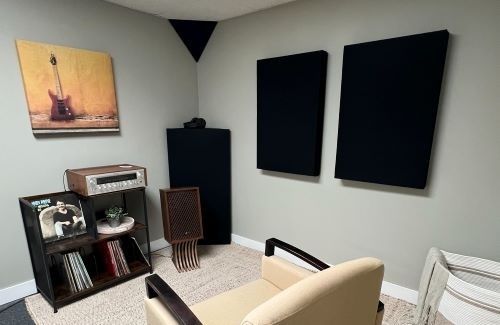
A useful evaluation cycle is deliberately repetitive. Measure the untreated room, change one variable, measure again, and compare both the response and the decay behavior. Do not celebrate a smoother line if the waterfall plot still shows a long tail. Likewise, do not reject a treatment because one narrow dip appears deeper if the overall ringing has shortened and the listening area has become more consistent. The target is not a perfect graph at one point, but a room that tells the truth over time and across a practical working zone.
Build a Room You Can Finally Trust
Reliable low end comes from balance. Physical positioning, speaker symmetry, bass trapping, and measured subwoofer integration should carry the main burden, while DSP handles the final polish. Equalization is valuable when used to reduce manageable peaks, but it cannot repeal interference, erase a null by force, or replace the acoustic work required to shorten modal decay.
Once the room stops exaggerating one note and deleting another, mixing becomes less like guessing and more like listening. The 808 can hit with controlled pressure, the bass guitar can retain its pitch, and decisions made at the desk are far more likely to survive a club system, car stereo, or headphone check. Before replacing the monitors, treat the room, move the chair, measure the decay, and let physics become part of the production workflow rather than the hidden opponent.

